Are you interested in understanding human behavior, emotions, thoughts, and relationships? An online psychology bachelor’s degree can be an excellent option if you want to explore the science of the mind while enjoying the flexibility of online education.
Psychology is a broad field that examines how people think, feel, learn, and interact with others. From understanding human development to exploring mental processes and social behavior, studying psychology can provide valuable knowledge for many career paths.
Today, numerous universities offer online undergraduate psychology programs designed for students with different educational backgrounds and schedules. These programs can help learners balance their studies with work, family responsibilities, or other commitments.
In this guide, we will explain what an online psychology degree involves, the subjects you may study, admission requirements, potential career opportunities, and how to choose the right university.
What Is an Online Psychology Bachelor’s Degree?
An online psychology bachelor’s degree is an undergraduate program that teaches students the fundamental principles of psychology through digital learning platforms.
Depending on the university, students may earn a Bachelor of Arts (BA) or Bachelor of Science (BS) in Psychology. Both degrees explore human behavior, although their course requirements and emphasis can differ between institutions.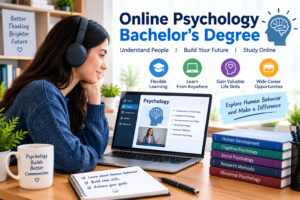
Students typically access lectures, reading materials, assignments, discussion boards, and assessments online. Some universities offer recorded lessons that students can complete at their own pace, while others require attendance at scheduled virtual classes.
The curriculum often includes psychological theories, research methods, human development, social behavior, and biological influences on mental processes.
Although the degree can provide a strong foundation in psychology, it does not automatically qualify graduates to practice independently as licensed psychologists. Additional education, supervised training, and professional licensing are generally required for that career path.
Benefits of Studying Psychology Online
Online education offers several advantages for students who want to pursue higher education without attending traditional campus classes every day.
1. Flexible Study Schedule
One of the main benefits of online learning is the ability to study from home or another suitable location.
Some programs allow students to complete recorded lessons and assignments around their existing schedules. This can be helpful for working adults, parents, and students who have other responsibilities.
However, flexibility varies by university. Before enrolling, check whether your chosen program follows fixed class schedules or offers self-paced coursework.
2. Learn About Human Behavior
Psychology helps students explore why people think, feel, and behave in different ways.
For example, you may study how childhood experiences influence development, how memory affects learning, or how social environments shape decision-making.
This knowledge can improve communication, critical thinking, and your understanding of different perspectives. These skills may be useful in professional environments as well as everyday life.
3. Access Learning Resources Online
Online programs often provide digital libraries, recorded lectures, research databases, and electronic course materials.
Students can revisit selected lessons, review notes, and use online academic resources when preparing for examinations or assignments.
The availability of these resources depends on the institution, so it is worth reviewing the learning platform before making a decision.
4. Balance Education With Other Commitments
An online psychology degree may allow students to continue working while completing their education.
For instance, someone employed in human resources or customer service might study psychology in the evenings to develop a better understanding of communication and workplace behavior.
Nevertheless, students should plan enough time for reading, research, assignments, and examinations to avoid becoming overwhelmed.
What Subjects Do Psychology Students Study?
The exact curriculum depends on the university and degree structure, but most undergraduate psychology programs cover several core areas.
Introduction to Psychology: Explores major psychological concepts, historical developments, and approaches to understanding behavior.
Developmental Psychology: Examines how people change physically, emotionally, socially, and cognitively throughout life.
Cognitive Psychology: Focuses on memory, attention, learning, language, reasoning, and problem-solving.
Social Psychology: Studies how other people, groups, and social situations influence individual behavior.
Biological Psychology: Investigates the relationships between the brain, nervous system, biological processes, and behavior.
Research Methods and Statistics: Teaches students how to evaluate psychological studies, understand data, and interpret research findings.
Abnormal Psychology: Introduces psychological disorders, their characteristics, and approaches used to understand mental health conditions.
Many programs also include electives in organizational psychology, personality, health psychology, or related subjects.
Students should review the course catalog carefully to ensure that the program matches their interests and future educational plans.
Admission Requirements for an Online Psychology Degree
Admission requirements vary by institution and country. Many undergraduate programs require a high school diploma or an equivalent qualification.
Some universities may consider previous academic performance, application forms, transcripts, personal statements, or standardized test results. Others offer more flexible admission pathways.
International students may need to provide translated academic documents, credential evaluations, or proof of English proficiency.
Before applying, verify the university’s recognition and accreditation status through the relevant official authority. If you plan to study from India, check whether the institution and specific online degree meet applicable University Grants Commission requirements.
It is also important to understand whether examinations, internships, laboratory activities, or other program requirements must be completed in person.
How Long Does an Online Psychology Bachelor’s Degree Take?
A traditional bachelor’s degree in psychology commonly takes about four years of full-time study in the United States.
However, completion time depends on the institution, course load, transfer credits, and program format.
Part-time students may take longer, while some accelerated programs allow eligible students to progress more quickly.
Certain universities accept credits from previous college courses or recognized learning experiences, potentially reducing the number of courses a student needs to complete.
Before enrolling, ask the university about its minimum completion period, maximum time limit, transfer-credit policy, and total graduation requirements.
Choosing a realistic schedule can help you complete your degree while maintaining a healthy balance between education and other responsibilities.
Career Opportunities After a Psychology Bachelor’s Degree
A bachelor’s degree in psychology can provide a foundation for several career paths. Available opportunities depend on your location, experience, additional qualifications, and the requirements of individual employers.
Potential options include:
- Human Resources Assistant: Supports recruitment, employee records, onboarding, and workplace administration.
- Research Assistant: Helps collect information, organize data, and support research projects.
- Community Support Worker: Assists eligible community programs and services, subject to local requirements.
- Market Research Assistant: Helps examine consumer preferences, customer behavior, and market trends.
- Case Management Assistant: Supports administrative and coordination tasks in appropriate service settings.
- Behavioral Health Support Staff: Works in eligible support roles under applicable training and supervision requirements.
- Customer Experience Specialist: Uses communication and behavioral insights to improve customer interactions.
Some positions require additional certifications, experience, or professional training.
If your goal is to become a licensed psychologist, therapist, or another regulated mental health professional, research the education and licensing requirements in the jurisdiction where you intend to work. A bachelor’s degree alone is generally insufficient for independent clinical practice.
How to Choose the Right Online Psychology Program
Selecting a university requires more than comparing tuition fees. You should evaluate the program’s academic quality, flexibility, recognition, and suitability for your long-term goals.
Check Accreditation and Recognition
Confirm that the university is appropriately recognized in its home country. If professional registration or postgraduate study is your goal, verify that the degree meets the relevant entry requirements.
Compare Tuition and Additional Costs
Review tuition fees, examination charges, technology fees, textbooks, and other required expenses.
A program with lower advertised tuition may not always be the least expensive option after additional costs are included.
Review the Curriculum
Compare the subjects, electives, research opportunities, and academic support available.
If you are interested in research, look for opportunities to develop statistical and research skills. If you are considering further study, review the prerequisites for your preferred postgraduate programs.
Understand the Online Format
Check whether classes are live, recorded, or self-paced. Also review examination arrangements, technical requirements, student support, and any compulsory campus visits.
Explore Student Support
Academic advising, library access, tutoring, career guidance, and technical assistance can make online learning more manageable.
Reading independent student reviews and speaking with current students may help you understand the learning experience.
Is an Online Psychology Bachelor’s Degree Worth It?
An online psychology degree may be worthwhile if you are interested in human behavior and want a flexible route to undergraduate education.
It can provide foundational knowledge for entry-level positions, related professional fields, and further academic study. Its value depends on the quality of the program, your career goals, and how effectively you apply what you learn.
However, psychology is not a shortcut to becoming a licensed mental health professional. Students interested in clinical practice should plan for the additional qualifications and supervised experience required by their chosen profession.
Before making a commitment, compare programs, calculate the total cost, and investigate realistic employment or postgraduate opportunities.
Conclusion
An online psychology bachelor’s degree offers students an opportunity to explore human behavior, develop research and communication skills, and prepare for a range of professional and educational pathways.
With subjects covering cognition, development, social behavior, and psychological research, the degree can provide a useful foundation for students interested in people and the science of the mind.
The best program is one that combines recognized academic credentials, a relevant curriculum, reasonable costs, and a learning format that fits your schedule.
Take time to research your options, confirm admission requirements, and consider your long-term plans before enrolling. With thoughtful preparation and consistent effort, online psychology education can become a meaningful step toward your academic and professional goals.